Tom Lake, the latest novel by the American writer Ann Patchett, is a story about families and relationships, about finding the value in the everyday and understanding what really matters.
At the centre of the 2023 novel, and its narrator, is Lara Nelson, who lives on a cherry farm in Michigan with her husband, Joe. It is summer 2020, the Covid pandemic is at its peak and lockdown has brought Lara and Joe’s three grown daughters, Emily, Maisie and Nell, back home. Whilst regular seasonal workers are thin on the ground, there are cherry trees to be harvested, so the girls are put to work. And this creates an opportunity for storytelling, as Lara tells her daughters – at their insistence – about her past, and the romance she had with a recently deceased Hollywood film star, Peter Duke.
Lara’s short-lived acting career had seen her perform on three occasions the leading role of Emily in Thornton Wilder’s 1938 play Our Town, an American classic about the value of everyday life and relationships in a small community. The third production takes place one summer in the fictional town of Tom Lake in Michigan where Lara acts alongside, and becomes romantically involved with, Duke, an unknown actor at the time. But both the relationship and Lara’s acting career come to an abrupt end when she tears her Achilles tendon whilst playing tennis. Replaced in both the play and the relationship by the understudy, Pallace, Lara decides to give up on acting. She initially remains in the theatrical world, working in costumes in New York, but a chance encounter with Joe Nelson, the director of the Tom Lake Our Town, leads to a change of direction. She and Joe fall in love, marry, and eventually decide to move back to Tom Lake, to the farm (with the cherry orchard) that has belonged to Joe’s family for the last five generations and which Joe is now ready to take on.
For Joe and Lara’s three daughters nothing could be more exciting than their mother’s close encounter with fame; for Lara nothing could be less interesting. As she says following the daughters’ discovery of her past love: ‘Thanks to his ubiquitous presence in the world, the man I’d spent a summer with took up residence in our home, and still I thought of him remarkably little.’
For Emily, Maisie and Nell nothing could also be less comprehensible than their parents’ decision to turn their back on the world of theatre (and potential fame) to farm the land instead: “’ You should have been famous,” Nell says finally. “I think that’s what kills me.”’
Lara is astounded by that, and by her daughters’ inability to appreciate the value of the world she now inhabits: ‘I lift up my hand to the lushness of trees. “Look at this! Look at the three of you! You think my life would have been better spent making commercials for lobster rolls?”’
What matters for Lara – and Joe – is the farm and their family; as Tom Lake is also a story about inheritance and legacy, what we get from the past and what we pass on to future generations.
The idea of inheritance and passing things on runs throughout the novel. Joe and Lara pass on the name Emily, from Our Town, to their first-born daughter, whilst Nell, the youngest, inherits her mother’s interest in, and aptitude, for acting. Objects are also passed down through the generations: Lara reflects on the fact that she is making quilts for her three daughters from dresses that belonged to them, to her (Lara) and to her mother and grandmother, and ‘My daughters will give these quilts to their daughters and those daughters will sleep beneath them. One day they will wrap their own children in these quilts, and all of this will happen on the farm.’
The fact that ‘all of this will happen on the farm’ is central to the notion of inheritance and legacy. And the farm’s cherry orchard is crucially symbolic, evoking Chekhov’s great drama The Cherry Orchard. Chekhov’s play, which was first performed in 1904, and is referred to by Duke on two occasions, revolves around an aristocratic landowner who allows the family estate, including a cherry orchard, to be sold off to a member of the new Russian middle class, illustrating themes of social mobility and social change.
Chekhov’s play is part of the literary inheritance of Patchett’s novel – as is Wilder’s Our Town – but also acts as a warning of what must not be done. When Lara first visits the farm Joe explains their financial difficulties – ‘”This business runs on a very small margin” – but bats away her well-intended suggestion that ‘”they sell off part of the land to pay the debts”’, saying ‘”Land gets sold when people die and the kids refuse to come home and take it over. Otherwise you keep the land”’.
Luckily for Joe and Lara the farm is safe for another generation: their daughter, Emily, who has recently graduated from agricultural college, will take it on with her fiancé, Benny, whose family own a neighbouring farm.
What will come next, however, is unknown. The novel’s pandemic setting highlights the uncertainties of life, with the climate crisis – and its potential impact on farming – adding another layer of unknowability. But Emily knows that, however bleak the forecast, there are still things to fight for: ‘Emily picks up a fork and balances it on one finger. She looks at nothing but the fork. “I can eat vegetables and ride my bike and stop using plastic bags, but I know I’m just doing it to keep myself from going crazy. The planet is fucked. There’s nothing I can do about that. But I’ll tell you what, I’m going to spend my life trying to save this farm. If anybody ever wonders what I’m here for, that’s it.”’
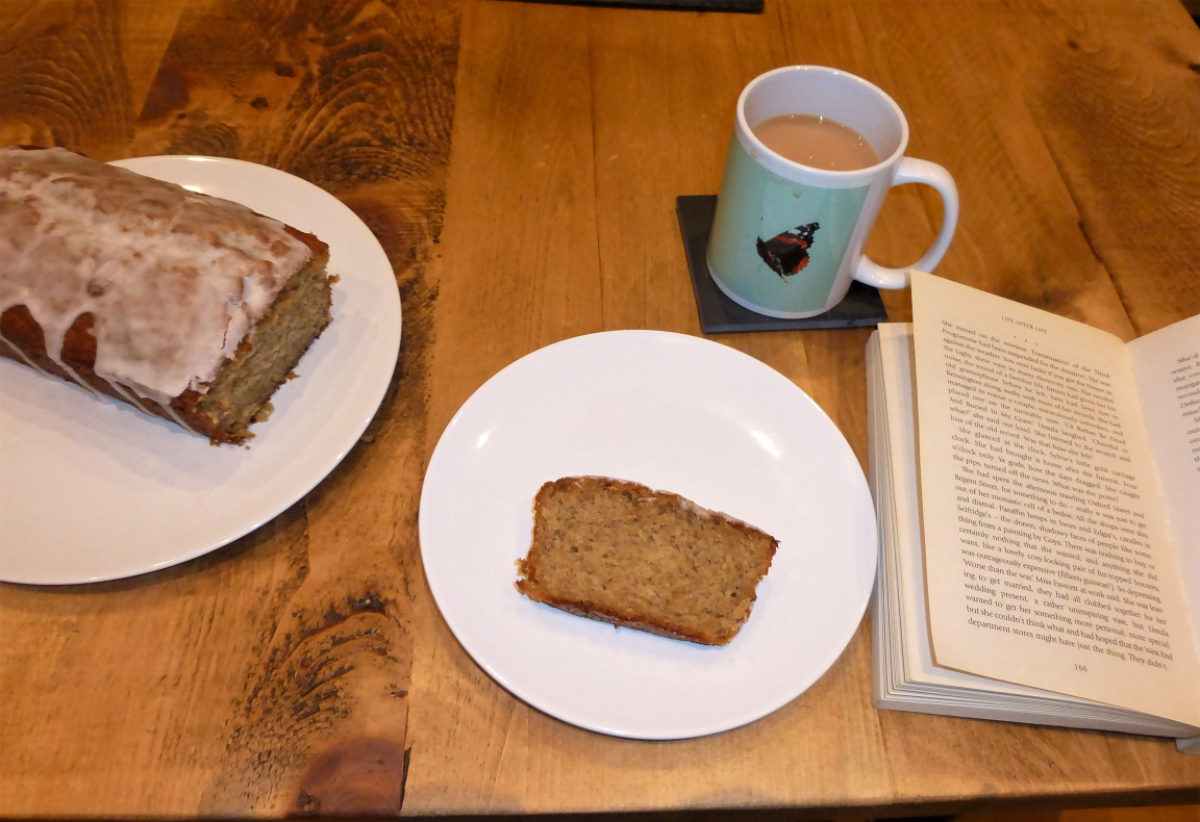
Whilst cherries are the most frequently mentioned foodstuff in the novel, another fruit seemed more appropriate for the theme of inheritance and legacy. When Emily and Benny announce their engagement, Lara and Joe want to celebrate with Benny’s parents but Covid restrictions, and also Benny’s mother’s asthma, make that impossible. Lara decides instead to make Benny’s mother, Gretel, ‘an apple cake to leave on her back porch’, carrying on a tradition which Gretel herself started when she came to the house the day after Lara and Joe moved in ‘an apple cake in her hands’.
APPLE CAKE:
Ingredients:
175g unsalted butter, softened
175g golden caster sugar
1 teaspoon vanilla extract
2 eggs, beaten
225g self-raising flour (or 205g plain flour plus 4 teaspoons baking powder)
½ teaspoon ground cinnamon
4 tablespoons Greek yoghurt
2 eating apples, peeled and grated
1 heaped tablespoon demerara sugar (optional for the topping)
Method:
Grease and line a loaf tin.
Heat the oven to 160C / 140C fan / Gas mark 3.
Beat together the sugar and butter until pale, then add the vanilla extract. Add the egg a small amount at a time, beating well between each addition.
Sieve the flour, baking powder (if using) and cinnamon and fold into the mixture, using a spatula or large metal spoon. Then fold in the yoghurt and peeled, grated apple.
Spoon the mixture into the lined cake tin. Sprinkle with the demerara sugar if using and bake in the preheated oven for between 1 hour 15 and 1 hour 30 minutes (though start checking after 1 hour), until risen, springy to the touch and a cake tester or skewer comes out clean when inserted.
Leave to cool initially in the tin, and then turn onto a wire rack to finish cooling.

Enjoyed yiur reflections on the book and made the apple cake – perfect for this time of year. Thank you.
Ah great – glad you enjoyed both the post and the recipe!